01 · RESEARCH
STAR
Systematic Toolchain for AI Research
Runs one research project from idea through reproducible experiments to paper-ready evidence.
STAR takes the STAGE to tell a STORY
The academic-writing companion to STAR — it turns a research project into a submitted paper without losing the chain of custody: every number traces to a fingerprinted evidence file or is visibly marked as missing, and every claim is tracked from proposal to verification in a single ledger.
The STAR family
Each works independently. Connect them when you want upstream work to flow downstream as fingerprinted, read-only evidence.
Systematic Toolchain for AI Research
Runs one research project from idea through reproducible experiments to paper-ready evidence.
Systematic Toolchain for Authoring, Guiding, and Editing
Turns one research contribution into a traceable paper, review cycle, and submission package.
Systematic Toolchain for Organizing Research over Years
Shapes graduate research into a defensible master's thesis or doctoral dissertation, defense, and deposit.
Why STAGE
Papers rot when numbers live in chat history and claims live in someone's head. STAGE moves the whole chain of custody — evidence, claims, reviews, submissions — into the repository.
Sections, figures with their sources, tables, bibliography, and venue styles each have one predictable home under manus/ — and it compiles out of the box.
STAR artifacts or hand-registered drops are snapshotted into mates/ with a fingerprint per file in MANIFEST.md. Evidence flows one way — never edited in place.
notes/claims.md links every claim's statements ⇄ evidence ⇄ status — proposed → drafted → verified — from the story seed to the submission.
Every number in manus/ either traces to a fingerprinted mates/ entry or is written as \todo{...} — no third state. Assertions about cited papers must be checkable against a reading note; venue rules enter only as user-confirmed facts. A visible \todo is a state; a plausible invented number is a defect.
bash execs/run.sh builds out-of-tree with latexmk; lint.sh mechanically fails on undefined references, \todo markers, page-limit overruns, and anonymity leaks. Everything that needs judgment stays with the sixteen skills.
Each venue attempt lives in cycls/<venue>_<year>/ with a user-confirmed venue.yml, received and simulated reviews, the response, and a frozen submission record — rejections included, so the next attempt starts where the last one ended.
The same sixteen skills ship for Claude Code, Codex, Cursor, DSH, Kimi Code, Pi, and Qwen Code, with shared skill files under .agents/skills/ and one neutral request router under .agents/commands/. Each run replies in English or Chinese and writes its notes and reports in the same language; the manuscript stays in English. Pair with a STAR repo for one-command evidence import, or work standalone with hand-registered drops.
Project structure
The abbreviated names follow STAR's convention: short to type, unambiguous to search, and identical across every paper you will ever write on STAGE.
manus/Manuscripts — the paper's LaTeX sourcesmates/Materials — fingerprinted evidence snapshots, read-onlynotes/Writing metadata — story, outline, and the claim ledgercycls/Cycles — one directory per submission attempttasks/Tasks — revision scratch and promise checkboxeswkdrs/Work directories — builds and ephemeral reports, never committedscpts/Scripts — evidence import and deterministic checksWriting workflow
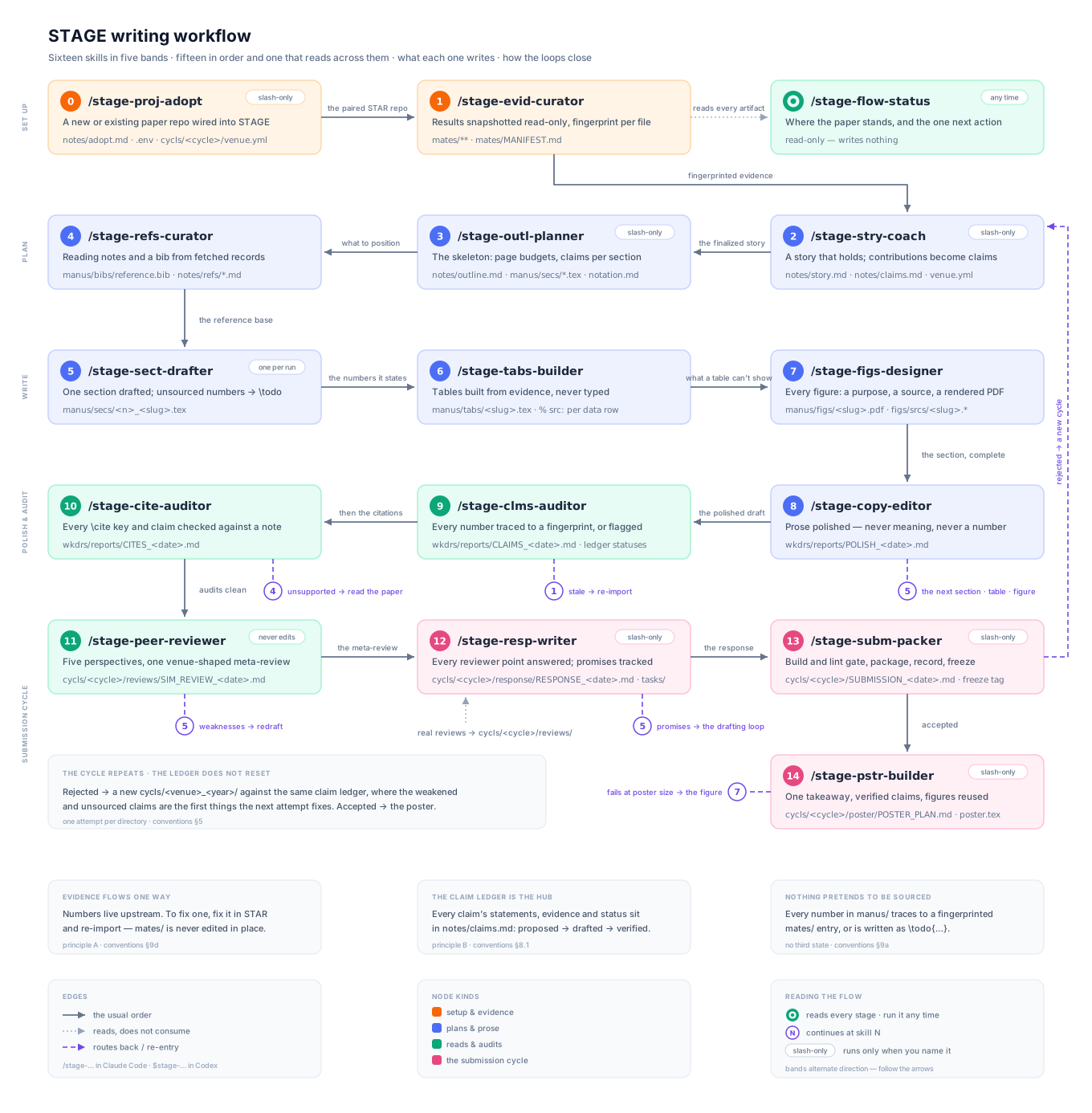
From imported evidence to a frozen submission — each skill writes its state into project files, so the whole paper is auditable and resumable at any point.
/stage-proj-adopt †Wire a new or existing paper repo into STAGE — numbers already in the draft become unsourced claims, not silent debt.
/stage-evid-curatorRun the import, register hand-dropped files, normalize messy exports, propose claim⇄evidence mappings.
/stage-stry-coach †Dialogue-first story shaping: pitch, contributions with claim IDs, venue rationale — seeds the claim ledger.
/stage-outl-planner †Story → skeleton: section page budgets, figure and table plans, claim→section assignment.
/stage-refs-curatorBibliography hygiene, reading notes with citable facts, topic search for work nobody named, related-work positioning.
/stage-sect-drafterOne section per run, from its brief, mapped evidence, and claims — missing numbers become \todo{}.
/stage-tabs-builderTables from mates/ evidence only — one % src: fingerprint comment per data row.
/stage-figs-designerEach figure end to end: purpose, editable source under figs/srcs/, rendered PDF.
/stage-copy-editorClarity, flow, and notation consistency — meaning and numbers untouchable.
/stage-clms-auditorExtracts every number and traces each to a fingerprint: matched / mismatched / unsourced.
/stage-cite-auditorEvery \cite resolves; every assertion about a cited work checkable against a reading note.
/stage-peer-reviewerA five-perspective simulated program committee under a citation-integrity contract.
/stage-resp-writer †Reviews → point ledger → response within the venue's limit, every promised change a checkbox.
/stage-subm-packer †Preflight, venue-template conversion from the official kit, package, submission record, freeze tag.
/stage-flow-statusRead-only map of the whole flow — outline, ledger, manifest, cycle state — and the single next action with its exact command. Never writes.
/stage-auto <goal>A command you type, not a skill: it runs stage-flow-status, then each unmarked skill your goal needs, one unit of work at a time, until the goal's check passes. It never starts the six † skills — it stops and prints the command for you to type — and every confirmation point is still asked. It never imports evidence, enters a venue fact, or commits on its own, and green lint is never its goal.
† marks the six slash-only skills: they run only when you name them, because the
decision points — adoption, story, outline, response, submission, and poster selection — stay yours.
Invoke a skill as /stage-<name> — $stage-<name> in Codex, /skill:stage-<name> in DeepSeek Harness and Kimi Code — and a goal run as /stage-auto ($stage-auto in Codex).
Quick start
Start fresh from the template — or run update.sh --adopt
inside an existing paper repo and STAGE installs its skeleton around your draft without moving a single file.
Ready when you are
STAGE is free, MIT-licensed, and agent-agnostic. Use it as a GitHub template, or adopt it into the paper you already have.