01 · RESEARCH
STAR
Systematic Toolchain for AI Research
Runs one research project from idea through reproducible experiments to paper-ready evidence.
STAR takes the STAGE to tell a STORY
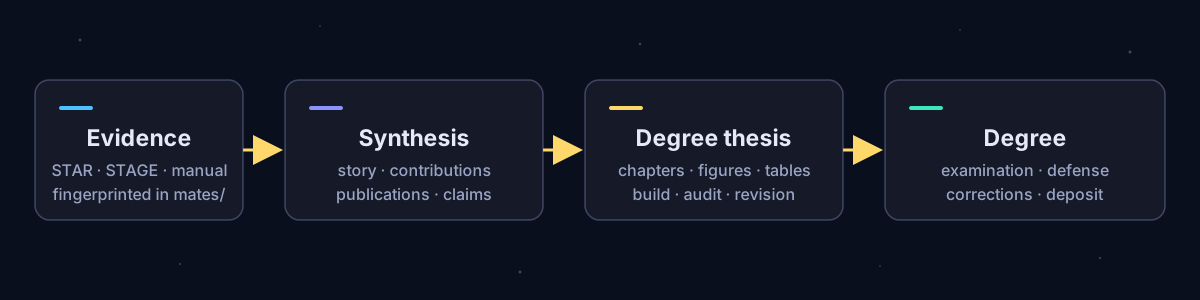
The master's and doctoral thesis companion to STAR and STAGE — it shapes graduate research, applicable publications, and fingerprinted evidence into one defensible, deposit-ready thesis: every number traces to an evidence file or is visibly marked as missing, reused publications keep their attribution, and committee comments and degree requirements stay on file.
The STAR family
Each works independently. Connect them when you want upstream work to flow downstream as fingerprinted, read-only evidence.
Systematic Toolchain for AI Research
Runs one research project from idea through reproducible experiments to paper-ready evidence.
Systematic Toolchain for Authoring, Guiding, and Editing
Turns one contribution into a traceable paper, review cycle, and submission package.
Systematic Toolchain for Organizing Research over Years
Shapes graduate research into a defensible master's thesis or doctoral dissertation, defense, and deposit.
Why STORY
A thesis rots when evidence lives in old repositories, numbers live in chat history, and attribution lives in someone's head. STORY moves the whole chain of custody — evidence, claims, publications, milestones — into the repository itself.
Front matter, chapters, appendices, figures, tables, and bibliography each have one predictable home under manus/ — and the template compiles out of the box, in English or 简体中文.
STAR research artifacts, STAGE paper materials, or hand-registered drops are snapshotted into mates/ with a fingerprint per file. Evidence flows one way — never edited in place.
notes/story.md owns the central argument, contributions.md maps each contribution to its evidence and chapters, outline.md holds the chapter architecture, and claims.md joins them as the ledger.
Every quantitative claim in manus/ either traces to a fingerprinted mates/ entry or is written as \todo{...} — no third state. Institutional rules and degree_level: master|doctoral enter degree/ only as author-confirmed facts; a published paper is evidence, never automatically the thesis's final wording. A visible \todo is a state; a plausible invented number is a defect.
notes/publications.md records which chapters reuse published material, who contributed what, and which permissions and overlaps apply. Evidence traceability never replaces authorship boundaries — STORY requires both, so collaborative work is never presented as solo work.
Each proposal, review, pre-defense, defense, correction, or deposit stage that the confirmed degree program requires lives in miles/<slug>/ — received feedback preserved verbatim, point-by-point responses, and a frozen outcome record. A deposit package cannot be declared ready while a required check or an open promise remains unresolved.
Sixteen skills ship for Codex, Claude Code, Cursor, DeepSeek Harness, Kimi Code, Pi, and Qwen Code from one shared skill source, and every run replies and writes in English or Chinese. Import evidence from any paired STAR or STAGE repository with one command, or work standalone with hand-registered drops.
What a session learns that no repository file owns — a TeX package missing on this machine, a standing preference, an approach a mock examination rejected — goes into .story/memory/, one file per fact with a one-line summary. At every session start, in every harness, a hook builds the index from those files and hands it to the agent. Memory only helps the agent find its way: it never stands in for evidence and never overrides degree/, mates/, notes/, or miles/. Facts true only of this machine stay in the git-ignored .story/memory/local/, and the agent records at most two memories a session, asking you first unless you set INVOLVE=low.
Project structure
The abbreviated names follow the STAR family convention: short to type, unambiguous to search, and identical across every STORY repository.
manus/Manuscripts — the thesis's LaTeX sourcesmates/Materials — fingerprinted evidence snapshots, read-onlydegree/Degree facts — author-confirmed institutional recordnotes/Writing metadata — story, outline, and the claim ledgermiles/Milestones — one directory per examination eventtasks/Tasks — durable open work and feedback promiseswkdrs/Work directories — builds and ephemeral reports, never committed.story/memory/Project memory — what sessions learned, indexed by hooks; never evidencescpts/Scripts — evidence import and deterministic checksDegree-aware thesis workflow
From imported evidence to a frozen deposit — each skill writes its state into project files, so the whole thesis is auditable and resumable at any point.
story-proj-adoptAdopt an existing master's or doctoral thesis without disturbing it — survey, record, and keep every institutional fact author-confirmed.
story-evid-curatorImport from STAR or STAGE repositories, register manual drops, refresh fingerprints, and integrity-check mates/.
story-syns-coachEstablish the research arc and degree contributions at the confirmed master's or doctoral level.
story-outl-plannerTurn the arc into a coherent chapter architecture, each chapter serving the thesis-wide argument.
story-refs-curatorVerified bibliography records and reading notes behind every literature assertion.
story-chap-drafterOne chapter or front/back-matter file per run, from its confirmed brief, the thesis story, and mapped evidence — missing numbers become \todo{}.
story-tabs-builderTables from mates/ evidence only — a % src: fingerprint anchor on every quantitative or comparative row.
story-figs-designerEach figure end to end: purpose, editable source, rendered PDF, evidence-mapped caption.
story-copy-editorClarity, voice, terminology, and cross-chapter flow — facts, numbers, and claim scope untouchable.
story-clms-auditorEvery number and comparison traced to a fingerprint: matched / mismatched / unsourced.
story-cite-auditorEvery \cite resolves; every literature assertion checkable against a reading note.
story-exam-reviewerA level-appropriate examiner pass over the built thesis — contribution scope, coherence, evidence, defense readiness.
story-revs-resolverTrack and resolve committee feedback point by point — received comments are never edited in place.
story-defn-builderPrepare and check an applicable defense deck against the thesis it presents.
story-depo-packerPreflight the deposit package against degree/ requirements and freeze the final record.
story-flow-statusRead-only map of chapters, claims, evidence, and milestone gates — and the single next action with its exact command. Never writes.
story-auto <goal>A command you type, not a skill: it runs story-flow-status, then each skill the handoff names toward your goal, one unit of work at a time. It never starts the six explicit-only skills — adoption, synthesis, outline, feedback, defense, deposit — and stops to name the command instead; every question only the author can answer is still asked. It never imports evidence, writes degree/ or received feedback, declares a deposit ready, commits, or pushes, and green lint is never its goal.
Every skill ships for Codex, Claude Code, Cursor,
DeepSeek Harness, Kimi Code, Pi, and Qwen Code
from one shared source under .agents/skills/, and every run replies and writes in English or Chinese.
Invoke a skill as /story-<name> — $story-<name> in Codex, /skill:story-<name> in DeepSeek Harness and Kimi Code — and a goal run as /story-auto ($story-auto in Codex).
Quick start
Start fresh from the template — the generic class compiles immediately, and institutional
templates and degree rules enter degree/
only as facts you have confirmed.
Get started
STORY is free, MIT-licensed, and agent-agnostic. Use it as a GitHub template, or adopt it into the master's or doctoral thesis you already have.